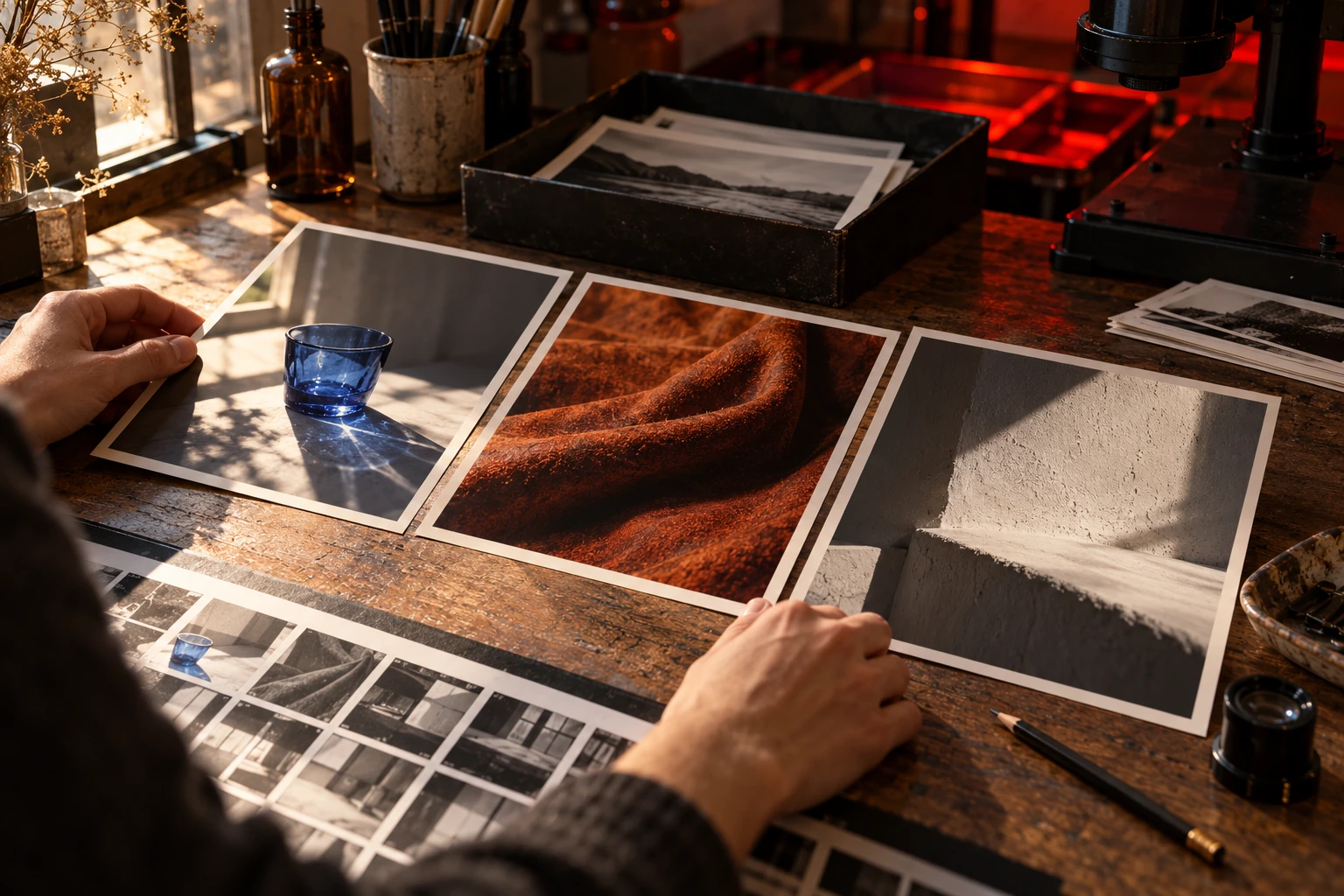
01 / Establish a visual question
Choose something ordinary: a window ledge, an object on a table or a small corner of a room. Write one sentence about the relationship you want to show. “The glass makes the cloth feel heavier” gives you a more precise starting point than “a beautiful still life.”
Make the first frame wide enough to locate the subject. Check the edges before you press the shutter. A bright fragment near the edge can compete with the subject even when it is not part of your idea. Record your starting position so that you can return to it.
02 / Change distance, then light
Make your second photograph closer, but keep the light and arrangement consistent. Look for a relationship rather than an isolated decorative detail: where two materials meet, where a shadow divides a surface or where a gesture leaves a trace.
For the third frame, change one thing deliberately. Move the light, lower the camera or turn the subject. Compare the result against your original sentence. If the new version is striking but says something unrelated, keep it as a separate possibility rather than forcing it into the sequence.
03 / Edit for rhythm
Place the first three images together. Add a quieter fourth frame that gives the reader time to connect them. It might contain less information or more open space. A pause still needs a role; it should change the tempo rather than merely fill a position.
Finish with an echo. Return to a colour, shape or distance introduced earlier, but let the intervening images change its meaning. Read the sequence in reverse, remove one frame and then restore it. If nothing changes when a frame disappears, ask whether it is carrying a necessary part of the story.
Keep the five images, your original sentence and one note about a decision you would repeat. The useful result is a clearer reason for choosing each frame.
Your working checklist
- Use the same subject for all five frames.
- Change one visual variable at a time.
- Compare images at similar sizes.
- Ask a viewer where their eye pauses before explaining your intent.